


Smart Casual for Men: The One-Smart-One-Casual Formula for Every Occasion
"Smart casual" is the most common dress code on invitations and the one men find hardest to decode. It sits between a T-shirt and a suit, and the space between those two is wide. This guide turns that gap into a simple, repeatable formula, then shows you how to adjust it for dates, weddings, graduations, restaurants and the office, through every season and at any budget.
Anchor it with good fit, neutral colors and clean footwear, and you will rarely get it wrong.
Key Highlights
- The formula: one smart piece plus one casual piece, anchored by good fit, neutral colors and clean footwear.
- Read the occasion: dates sit at the relaxed end, weddings and graduations at the smart end, and restaurants and offices depend on the venue and the crowd.
- When unsure, go one notch up: an unstructured blazer is the easiest way to fix an outfit that feels underdressed, and you can take it off.
- Swap by season, not by rule: linen and polos in summer, fine knits and wool layers in autumn and winter.
- Avoid the big four: athletic sneakers, distressed jeans, graphic tees under a blazer and poor fit.
- Start small: a 10-piece capsule covers everything from dates to weddings, and a complete outfit is possible for under $150.
In this guide
What Smart Casual Actually Means
Smart casual is a balance, not a uniform. Take one piece from the "smart" side of your wardrobe (a collared shirt, a fine knit, tailored trousers, an unstructured blazer, leather shoes) and pair it with one piece from the "casual" side (dark jeans, a polo, clean minimalist sneakers, a bomber). The smart piece signals effort. The casual piece keeps the outfit from looking like you came straight from a meeting.
Three things hold the formula together:
- Fit. Shoulders that sit on your shoulders, sleeves that end at the wrist bone, and trousers with little or no break. Fit matters more than brand or price. Our guides to slim fit and regular fit break down exactly what those labels mean in measurements and body types.
- Neutral colors. Navy, grey, stone, olive, white and light blue all combine with each other, so every piece works with the rest of your wardrobe.
- Clean footwear. Shoes make or break the outfit. Scuffed or athletic shoes undo even a good blazer.
Occasion Guide
Smart casual shifts depending on where you are going and who will be there. The same outfit that works for a relaxed dinner can look underdressed at a graduation ceremony. Use the guidance below to adjust the baseline formula without starting from scratch.
Dates
A date calls for the relaxed end of smart casual. You want to look intentional but not stiff, and you want the focus on the conversation, not on whether your blazer is too formal.
- Top An untucked Oxford cloth button-down or a fine-gauge merino knit such as a slim-fit quarter-zip knit. A quality polo works for daytime dates in warm weather.
- Bottom Dark-wash jeans without distressing, or tailored chinos in navy, stone or olive.
- Shoes Minimalist leather sneakers, desert boots or loafers. Avoid anything athletic or overly shiny.
- Layer A bomber jacket or an unstructured blazer if the evening cools down.
For a first date, lean one notch more relaxed than you think you need. A knit over dark jeans with clean leather sneakers reads as confident and comfortable, while a full blazer and tie can feel like you are trying too hard.


Weddings
Weddings are where most men get smart casual wrong. The invitation may say smart casual, but the setting and time of day matter more than the label.
- Top A collared shirt, ideally in a solid or subtle pattern. A knit over a collared shirt adds depth without a tie.
- Bottom Tailored chinos or dress trousers. Dark jeans are acceptable only for very casual outdoor or beach weddings, and only if the invitation explicitly allows them.
- Shoes Loafers, Chelsea boots or clean leather derbies. Avoid sneakers unless the wedding is explicitly casual.
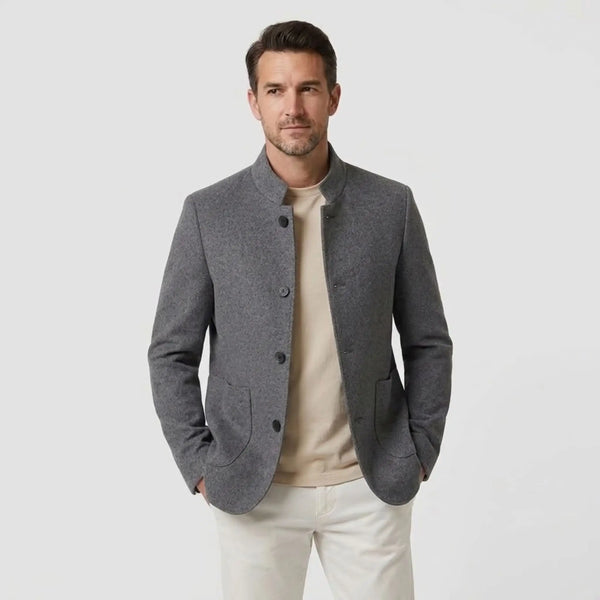
- Layer An unstructured blazer in navy, grey or a soft earth tone, such as a loose-fit wool suit coat. This is the single most useful piece for weddings.
When in doubt, dress one notch above the expected baseline. A blazer over a knit and tailored chinos is almost never wrong for a smart casual wedding, while a polo and sneakers can be a costly mistake.
The question we hear most often before a summer wedding is "can I skip the blazer?" Our answer is to bring it anyway. You can always take it off once the dancing starts, but you cannot add one in the ceremony photos. For hot outdoor weddings, a long-sleeve linen-look shirt with tailored trousers in a muted tone keeps you cool without looking underdressed.


Graduations
Graduations are celebratory but often involve sitting for long periods and walking across campus. The smarter end of smart casual is appropriate, especially if you are a guest of honor or will appear in photos.
- Top A button-down shirt, tucked or untucked depending on the fit. A knit over a collared shirt works well for cooler weather.
- Bottom Tailored chinos or dress trousers. Dark jeans are acceptable if the event is outdoors and casual, but chinos are the safer choice.
- Shoes Loafers, Chelsea boots or clean leather sneakers. Avoid anything too casual like canvas sneakers or sandals.
- Layer An unstructured blazer or a lightweight knit layer like a lapel-collar cardigan. This lifts the outfit without looking like you are going to a board meeting.
Graduations often involve a lot of standing and walking, so prioritize comfortable shoes that still look polished. A broken-in pair of loafers or minimalist leather sneakers beats stiff new dress shoes.
Restaurants
Restaurant smart casual depends on the venue. A neighborhood bistro is different from a high-end steakhouse, but the same core pieces work with small adjustments.
- Top A collared shirt or a quality knit. A polo is fine for casual lunch spots but may feel underdressed for dinner at a nicer restaurant.
- Bottom Dark jeans or chinos. Chinos are the safer choice for upscale restaurants.
- Shoes Leather sneakers, loafers or Chelsea boots. Avoid athletic sneakers and flip-flops.
- Layer A bomber jacket, unstructured blazer or a clean overshirt such as a cotton chore coat, depending on the formality of the venue.
Check the restaurant's website or social media for photos of diners. If most men are in collared shirts and leather shoes, match that level. If you see jeans and sneakers, you can relax the formula.
Office
Smart casual in the office varies widely by industry and company culture. The goal is to look competent and approachable without wearing a full suit.
- Top An Oxford cloth button-down, a fine-gauge knit or a quality polo like a long-sleeve cotton polo. Avoid graphic tees and anything wrinkled.
- Bottom Tailored chinos, or dark jeans if your office allows them. Chinos are the default for most smart casual offices.
- Shoes Loafers, Chelsea boots or minimalist leather sneakers. Avoid athletic sneakers unless your office is explicitly very casual.
- Layer An unstructured blazer, or a V-neck wool sweater worn over a collared shirt, for meetings and presentations.
Keep a spare blazer or knit at your desk. If a last-minute meeting comes up, you can add a layer and instantly look more put-together without changing your whole outfit.


Smart Casual vs Business Casual vs Casual
The table below shows the differences between the three most confused dress codes at a glance. Use it as a quick reference when you are unsure which category an outfit falls into.
| Dress code | Typical tops | Typical bottoms | Typical shoes | Example occasions |
|---|---|---|---|---|
| Casual | T-shirt, henley, hoodie, casual polo | Jeans, chinos, shorts | Sneakers, canvas shoes, sandals | Running errands, casual hangouts, weekend activities |
| Smart casual | Oxford shirt, fine-gauge knit, quality polo, unstructured blazer | Dark jeans without distressing, tailored chinos | Minimalist leather sneakers, loafers, Chelsea boots, desert boots | Dates, weddings, graduations, nice restaurants, smart casual office |
| Business casual | Button-down shirt, knit, blazer, dress shirt without tie | Dress trousers, chinos, no jeans in most offices | Leather derbies, loafers, oxfords, no sneakers | Office, client meetings, business lunches, conferences |
Industry note: Jeans are the biggest grey area. In finance, law and client-facing consulting, business casual almost never includes denim. In tech, creative and start-up workplaces, dark jeans are often accepted even under the business casual label. When in doubt, look at what senior colleagues wear on an ordinary day.
The quickest test we use: if you could wear the outfit to a client lunch without a blazer, it is business casual. If it needs the blazer to feel "enough," it is smart casual. If the blazer would look out of place, it is casual.
Seasonal Smart Casual Matrix
Smart casual is not a single outfit. The same principles work year-round, but fabrics, layers and footwear change with the weather. Use this matrix to swap pieces without losing the smart casual balance.
| Season | Top swap | Bottom swap | Shoe swap | Layer swap |
|---|---|---|---|---|
| Spring | Oxford shirt or lightweight knit | Chinos in stone or olive | Loafers or minimalist leather sneakers | Unstructured blazer or light overshirt |
| Summer | Linen shirt, quality polo or lightweight knit | Chinos or dark jeans in lighter weights | Loafers, minimalist leather sneakers or clean canvas sneakers | No layer, or a linen overshirt for evenings |
| Autumn | Fine-gauge merino knit or Oxford shirt | Dark jeans or chinos in navy or olive | Chelsea boots or desert boots | Unstructured blazer or knit blazer |
| Winter | Merino or cashmere knit over a collared shirt | Dark jeans or heavier chinos | Chelsea boots or leather derbies | Wool overcoat or heavier unstructured blazer |
Shop by season: for warm months, start with a linen-blend shirt or a linen jacquard polo from our Summer Collection. For colder months, layer a half-zip cotton sweater under a double-faced wool overcoat, or browse the full Winter Collection.
Climate note: In a Nordic winter or any climate that regularly drops below freezing, the overcoat does most of the work. Keep the smart casual balance underneath (knit plus chinos or dark jeans) and switch to lug-soled Chelsea boots for grip. In hot, humid climates, drop the layer entirely and let breathable natural fibers like linen and cotton carry the "smart" side.


Autumn is the easiest season for smart casual, because a knit over a collared shirt instantly hits the formula. Summer is the hardest. Without a layer, the smart piece has to be the shirt itself, so choose a collar with structure, like a Cuban or stand collar in linen, over a plain tee.
Dress Code Decoder
Don't want to read every rule? Answer three quick questions and get a specific outfit. This is the same process our stylists use when customers ask what to wear to a specific event.
Pick your event to reveal the outfit:
Date
Outfit: Fine-gauge knit or untucked Oxford shirt + dark jeans + minimalist leather sneakers.
Adjust: Evening or upscale venue: add an unstructured blazer and swap the sneakers for loafers. Daytime and outdoors: switch the knit for a quality polo.
Wedding
Outfit: Unstructured blazer + collared shirt or knit + tailored chinos + loafers.
Adjust: Beach or garden, daytime: lighter colors, linen shirt, blazer optional during the reception. Evening or formal venue: darker blazer, Chelsea boots or derbies, no jeans.
Graduation
Outfit: Button-down shirt + tailored chinos + loafers or clean leather sneakers, with a blazer or knit layer.
Adjust: If you are the graduate or in family photos, keep the blazer on. Long outdoor ceremony: prioritize comfortable, broken-in shoes.
Restaurant
Outfit: Collared shirt or quality knit + dark jeans or chinos + leather sneakers or loafers.
Adjust: Upscale dinner: chinos and a blazer. Casual lunch with friends: polo and dark jeans are fine.
Office
Outfit: Oxford shirt or fine knit + tailored chinos + loafers or minimalist leather sneakers.
Adjust: Meeting clients: add a blazer and choose leather shoes. Internal day in a casual office: a quality polo and dark jeans work.
Something else
Outfit: Dark jeans or chinos + collared shirt or quality knit + leather shoes or clean sneakers.
Adjust: If you are unsure, add an unstructured blazer. It is easier to take a layer off than to wish you had one.
The crowd question matters more than most people expect. The same restaurant dinner calls for a polo with friends but a collared shirt and blazer with your partner's parents or a client. When the crowd is mixed, dress for the most formal person you will meet.
Common Mistakes and Fixes
Most men err by dressing either too casual or too formal. Here are the most common mistakes, each with a direct fix, so you can self-correct before you leave the house.
- Mistake: Wearing a full suit without a tie. Fix: Replace the suit jacket with an unstructured blazer, or swap the dress trousers for dark jeans or chinos. Keep the shirt and shoes.
- Mistake: Wearing athletic sneakers with chinos and a button-down. Fix: Swap the athletic sneakers for minimalist leather sneakers, loafers or Chelsea boots. The rest of the outfit can stay the same.
- Mistake: Wearing a graphic tee under a blazer. Fix: Replace the graphic tee with a plain crew-neck tee, a quality polo or an Oxford shirt. The blazer then reads as intentional.
- Mistake: Wearing distressed or faded jeans. Fix: Choose dark-wash jeans with no holes, fading or heavy distressing. Slim or straight fits work best.
- Mistake: Wearing wrinkled or ill-fitting clothing. Fix: Iron or steam key pieces, and get shirts and trousers tailored if needed. Fit matters more than brand or price.
When in doubt, dress one notch above the expected baseline. Underdressing is harder to recover from than overdressing, and a simple layer like a blazer or knit can be removed if you feel too formal.
The mistake we see most in fit photos is not the wrong item but the wrong size: a polo with sleeves past the elbow, or a sweater pooling at the waist. Check the size guide on every product page and measure a piece you already love. It takes two minutes and saves a return.
Budget-Tiered Outfit Formulas
Building a smart casual wardrobe does not require a large budget. The same core pieces can be sourced at different price points. The formulas below show how to put together a complete outfit, shoes included, at three spending levels.
Under $150
A complete outfit at the entry price point, prioritizing fit over brand.
- Top: A well-fitting Oxford shirt or a quality polo, such as a slim-fit striped knit polo.
- Bottom: Dark-wash jeans or chinos with a good fit.
- Shoes: Clean minimalist leather sneakers or simple loafers.
- Layer: Skip the blazer. Use a clean overshirt or a fine-gauge knit if the budget allows.
$150 to $400
The core wardrobe tier, building the pieces you will wear most.
- Top: An Oxford cloth button-down and a fine-gauge merino knit.
- Bottom: Tailored chinos in navy or stone, plus dark-wash jeans.
- Shoes: A quality pair of minimalist leather sneakers or loafers.
- Layer: An unstructured blazer in a neutral color.
$400 and Above
The full wardrobe tier, focusing on quality fabrics and variety.
- Top: Multiple Oxford shirts, a cashmere or merino knit and a quality polo.
- Bottom: Tailored chinos in two or three neutral tones, plus dark-wash jeans.
- Shoes: Loafers, Chelsea boots and minimalist leather sneakers.
- Layer: An unstructured blazer and a knit blazer for variety.
Under $150: Prioritize fit over brand. A well-fitting inexpensive shirt looks smarter than an ill-fitting designer one, so spend a little on tailoring if needed.
$150 to $400: Invest in the blazer and shoes first, as these have the biggest impact on the overall look. Chinos and shirts can be rotated more often.
$400 and above: Focus on quality fabrics like merino wool, cotton and linen blends. These drape better and look more intentional than cheap synthetics.
The best value at the entry tier is a matching set. A coordinated top and trousers removes the guesswork about what goes together and costs less than buying both pieces separately. Our two-piece polo outfits and pieces like the twist knit polo and slim trouser set cover the top and bottom of the formula in one purchase, leaving most of a $150 budget for shoes.
The 10-Piece Smart Casual Capsule Wardrobe
A small set of interchangeable pieces can create many outfits and solve the budget and overwhelm problems at once. This capsule is built from the core essentials covered above.
- Unstructured blazer in navy or grey
- Tailored chinos in navy
- Tailored chinos in stone or olive
- Dark-wash jeans, no distressing
- Oxford shirt in white or light blue
- Fine-gauge merino or cashmere knit
- Quality polo in a solid color
- Minimalist leather sneakers
- Loafers or Chelsea boots
- Leather belt and a simple watch
Four outfits from the same ten pieces:
Rotate the belt and watch (10) through all of them. Swapping just one piece per outfit creates well over a dozen combinations.

If you can only buy one piece this month, make it the knit. It works over a collared shirt in autumn, alone with jeans on a date and under a blazer at a wedding. No other item in the capsule covers as many of the outfits above.
Frequently Asked Questions
Can I wear jeans to a smart casual event?
Yes, as long as they are dark-wash, well fitted and free of rips, fading or heavy distressing. Pair them with a smart piece such as a collared shirt, fine knit or blazer. The exception is weddings, where tailored chinos are safer unless the invitation clearly signals a relaxed event. For the full breakdown on when they work and when they don't, see our guide to wearing jeans smart casual.
Are sneakers smart casual?
Minimalist leather sneakers in white, black or tan are smart casual. Running shoes, gym trainers and chunky athletic styles are not. Keep them clean, because scuffed sneakers pull the whole outfit down.
Do I need a blazer for smart casual?
No. A blazer is the easiest way to hit the "smart" side of the formula, but a collared shirt or fine knit can do the same job. Bring one when the event is a wedding, a graduation or an evening at an upscale venue.
Is a polo shirt smart casual?
A quality polo with a structured collar in a solid color or subtle knit pattern is smart casual, especially for daytime, warm-weather events and casual offices. Pair it with chinos or dark jeans and leather shoes. Avoid sporty, logo-heavy or faded polos.
What is the difference between smart casual and business casual?
Business casual leans more formal: dress trousers, leather shoes and usually no jeans or sneakers. Smart casual allows dark jeans, polos and minimalist leather sneakers, as long as at least one piece of the outfit is clearly "smart."
Can I wear shorts for smart casual?
Generally no. Tailored shorts with a linen shirt and loafers can work for a summer daytime gathering or a resort setting, but for weddings, graduations, offices and most restaurants, trousers are the safer choice.
How We Wrote This Guide
This guide is written and maintained by the MannerCo Style Team, the same team that selects, fits and styles every piece in our menswear range. Our recommendations combine three sources:
- Hands-on styling. We wear and photograph the pieces we recommend, and we test combinations on real fits rather than mood boards. For example, we recommend an unstructured, soft-shouldered blazer for smart casual because it has little or no padding and a lighter lining, so it drapes naturally over a knit instead of bunching at the shoulders the way a structured suit jacket does.
- Customer questions. The occasions, mistakes and FAQs in this guide reflect what customers ask us most before weddings, dates and job interviews.
- Established menswear sources. We cross-check formality rules against leading publications, including FashionBeans' smart casual dress code guide, Ape to Gentleman's guide to the smart casual dress code and the history and definition of smart casual on Wikipedia.
Every guide is reviewed at the start of each season and updated when dress code norms, fabrics or price points change. This guide was last reviewed on October 2, 2026. Spotted something out of date? Contact us at support@mannerco.com.
The Bottom Line
Smart casual is not a mystery. It is a simple balance of one smart piece and one casual piece, anchored by fit, neutral colors and clean footwear. Once you understand where it sits on the formality scale and how to adjust it for the occasion, you can walk into any event with confidence.
The next time an invitation says smart casual, don't panic. Start with dark jeans or chinos, add a collared shirt or quality knit, and finish with leather shoes or clean sneakers. If you are unsure, add an unstructured blazer and you will almost always be in the right zone.
Bookmark this guide or screenshot the comparison table. The next time a dress code confuses you, you will have a quick reference that takes the guesswork out of getting dressed.
If you take away only one habit, make it this: lay the outfit out the night before and ask, "which piece is my smart piece?" If you can't name one, add a collar or a blazer. If everything is smart, swap one item for denim or clean sneakers. That single check fixes most smart casual mistakes.
Build Your Smart Casual Wardrobe
Knits, polos, shirts and layers chosen to fit the formula.
SweatersPolo ShirtsJacketsTwo-Piece Sets